The Future of Test Automation: AI and Beyond
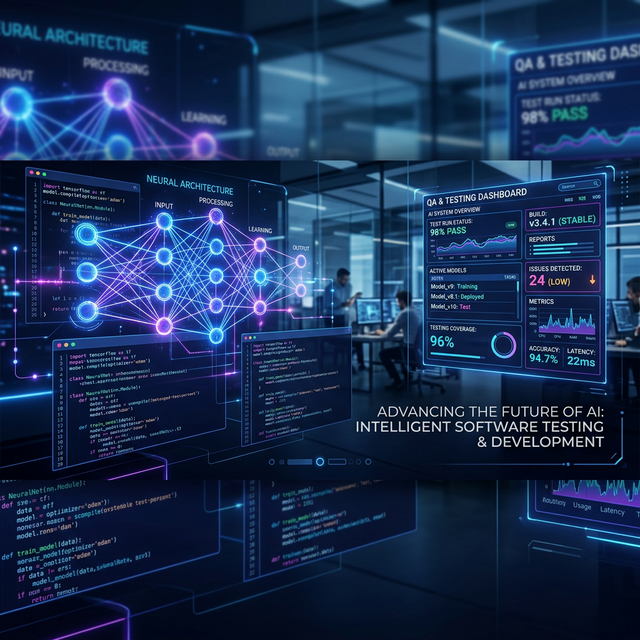
Software development is evolving rapidly, and quality assurance must evolve with it. Traditional testing methods, while still important, are no longer sufficient for modern agile and DevOps environments. Test automation has already transformed the way teams ensure product quality — but the future of test automation goes far beyond scripts and frameworks.
With the rise of Artificial Intelligence (AI), machine learning, and intelligent analytics, the next generation of testing is becoming smarter, faster, and more efficient than ever before.
In this article, we will explore how AI is shaping the future of test automation and what lies beyond conventional automation tools.
The Evolution of Test Automation
In the early days, testing was primarily manual. QA engineers executed test cases step by step, which was time-consuming and prone to human error.
Then came automation tools such as:
- Selenium
- JUnit
- TestNG
- Cypress
These tools allowed teams to automate repetitive test cases, improve speed, and increase regression coverage.
However, traditional automation still requires:
- Script maintenance
- Frequent updates when UI changes
- Manual test case design
- Skilled technical expertise
This is where AI begins to change the landscape.
How AI Is Transforming Test Automation
Artificial Intelligence is introducing intelligence into testing systems. Instead of relying solely on predefined scripts, AI-powered tools can learn from application behavior and adapt automatically.
Here are the key areas where AI is making an impact:
1. Self-Healing Test Scripts
One of the biggest challenges in automation is test failure due to minor UI changes.
AI-powered testing tools can:
- Detect element changes
- Automatically update locators
- Reduce maintenance effort
This dramatically decreases false failures and improves stability.
2. Intelligent Test Case Generation
AI can analyze:
- User behavior
- Application workflows
- Production data
Based on this data, it can automatically generate optimized test cases that cover real-world usage patterns instead of hypothetical scenarios.
3. Predictive Defect Analysis
AI systems can analyze historical defect data and:
- Predict high-risk modules
- Identify patterns in failures
- Suggest priority testing areas
This allows QA teams to focus on critical components rather than testing everything equally.
4. Visual Testing and Image Recognition
Modern applications rely heavily on UI/UX. AI-powered visual testing tools can:
- Detect layout shifts
- Identify missing elements
- Compare design inconsistencies
- Recognize visual regressions
This is much more advanced than traditional pixel-by-pixel comparison methods.
The Role of Machine Learning in QA
Machine learning algorithms improve over time. As more test data is collected, the system becomes better at identifying flaky tests, detecting unstable environments, reducing duplicate test cases, and optimizing test execution time. This makes automation smarter rather than just faster.
Beyond AI: The Next Phase of Test Automation
While AI is transforming automation, the future goes even further.
1. Continuous Testing in DevOps
With DevOps pipelines, testing is integrated into every stage of development. Tools like Jenkins, GitHub Actions, and GitLab CI/CD enable continuous integration and continuous testing, ensuring bugs are detected early.
2. Low-Code/No-Code
Modern platforms are enabling non-technical testers to build automation workflows without deep programming knowledge. This democratizes automation and reduces dependency on developers.
3. Cloud Testing
Cloud testing platforms provide scalable infrastructure, cross-browser/device testing, and faster execution environments. This removes hardware limitations and accelerates release cycles.
4. Shift-Left and Shift-Right
Future QA strategies focus on testing earlier in development (Shift-Left) and monitoring real user behavior after deployment (Shift-Right). This improves product quality and user satisfaction.
Challenges of AI in Test Automation
Despite its benefits, AI-based automation has challenges:
- High initial implementation cost
- Data dependency
- Learning curve
- Tool selection complexity
Organizations must evaluate their needs before adopting AI-driven testing solutions.
Skills QA Engineers Need for the Future
To stay competitive, QA professionals should focus on:
"The future QA engineer is not just a tester — but a quality strategist."
Conclusion
The future of test automation is intelligent, adaptive, and deeply integrated into the software development lifecycle. AI is not replacing testers — it is empowering them to focus on strategic, high-value tasks.
As technology evolves, QA professionals who embrace AI-driven tools and continuous testing practices will lead the industry forward.
Test automation is no longer just about running scripts. It is about building smarter systems that ensure quality at speed — and the journey has only just begun.